Arkansas Imagination library
PROGRAM IMPACTArkansas Imagination Library ignites a passion for reading in young children by mailing one high-quality, age-appropriate book each month. The books strengthen emotional relationships with loved ones, and enhance cognitive skills, leading to significant educational advancements.

Importance of Early Literacy
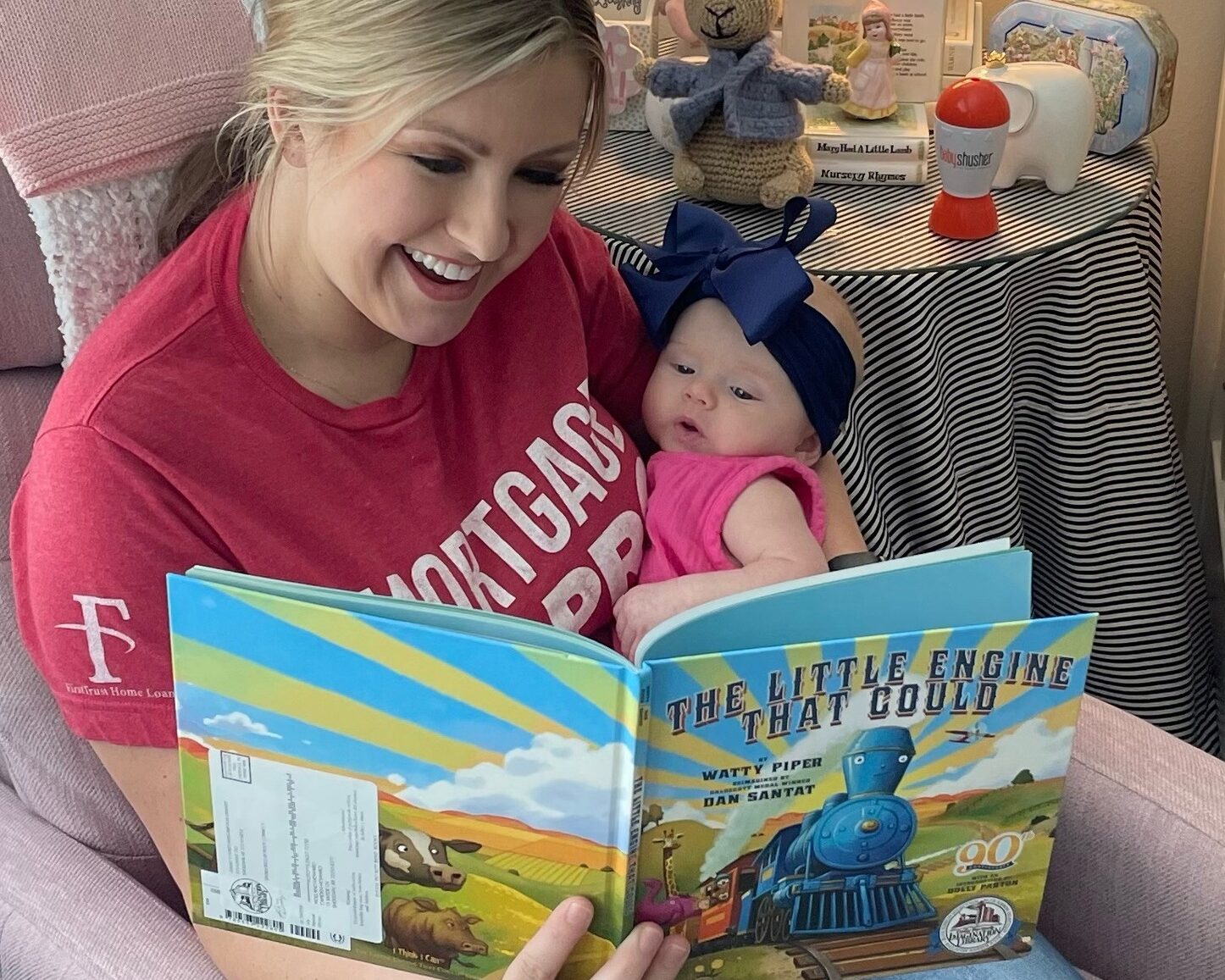
Reading with a child isn’t just about words—it’s about love, connection, and the joy of discovery. Studies show that children who experience regular shared reading with caregivers develop stronger emotional bonds, leading to greater confidence and social skills.
Beyond academics, these reading moments become a source of warmth and stability. A child who is read to daily hears up to 1.4 million more words* before entering kindergarten. But more importantly, a child associates books with comfort, attention, and love— laying the foundation for a lifetime of curiosity, connection, and learning.
Children with at least 25 books in the home complete an average of two more years of schooling than those with no books (Evans, 2017).
Children who read at home 3 times per week are more likely to recognize letters, count to 20, and write their name before entering school (Nord, 1999).
Reading aloud is widely recognized as the single most important activity for enhancing a child’s language and development (National Academy of Education, 1985).
Impact on Arkansas Families

With a child’s brain forming 1 million connections per second* in the early years, reaching 80% of development by age three*, reading is a key component to their future success. Having access to books in the home is a critical component. Children with at least 25 books in the home complete an average of two more years of schooling than children with no books at home.
Arkansas Imagination Library bridges this gap by delivering personalized books directly to the child’s home, giving them easy access to high-quality, age-appropriate books.
Our program makes reading accessible, exciting, and most importantly…FUN! Over 6.5 million books have been delivered to Arkansas children, fostering a love of reading that will carry them into the future.
Children who read often are less likely to feel nervous, anxious, sad, or lonely compared to those who read infrequently.
– Scholastic Kids & Family Reading Report, 2022
The greater access the child has to books in school and at home, the more likely they are able to cultivate an appreciation for diverse experiences and develop empathy for others.
– Reading for Life: The Impact of Youth Literacy on Health Outcome, 2020
61% of US Children living at or below the poverty level have no books in the home.
– Reading is Fundamental
The Dollywood Foundation International Study
Dolly Parton’s Imagination Library has gifted millions of books to children from birth to age five. Now, a groundbreaking international study – the largest dataset ever collected on shared book reading – reaffirms th eprogram’s powerful impact.
Led by researcher Dr. Claire Galea, the study surveyed more than 86,000 caregivers across the United States, Canada, the United Kingdom, Ireland, and Australia. Families were followed for twelve months and compared with caregivers whose children had not yet received books. Learn More…
2026 Arkansas Parent Survey
Arkansas families are seeing the impact of Imagination Library every day!
Our first statewide Parent Survey shows that families are reading more often, children are more interested in books, and parents feel more confident reading together. For some families, these books are making an even bigger difference—providing access to books that weren’t previously in the home. Learn more…
Improving School Readiness in Arkansas 2023
In 2023, ARIL and the Arkansas Research Center analyzed Qualls Kindergarten Readiness Assessment scores that all preschool children took from 2013-2017. The analysis revealed that enrolled children were more school-ready and performed 5-10% better than unenrolled peers, particularly among low socioeconomic groups. This indicates that the Imagination Library program helps close both opportunity and achievement gaps. Learn More…
Arkansas Imagination Library Impact Report 2021
Young children whose parents read to them, tell stories, and sing songs become better readers and perform better in school. But almost 2/3rds of Arkansas children start kindergarten unprepared, lagging their peers in critical language, math, and social-emotional skills.
According to the Arkansas Community Foundation’s Aspire Arkansas Report (2023), only 32% of Arkansas third graders are proficient in reading. Third grade is considered an important milestone in a student’s career in terms of reading proficiency and is correlated to whether a student will graduate from high school. The Aspire Arkansas report indicates that, in school districts in distress, third grade reading proficiency levels are below the state average.
ARIL completed the first impact study in 2021. ARIL partnered with the Arkansas Department of Education, the Dollywood Foundation, the Arkansas Research Center, and the University of Central Arkansas to analyze student achievement among students that participated in the Imagination Library – going back to 2010 – and those students that did not participate in the program. This research demonstrated that enrollment in DPIL decreases retention, and increases kindergarten readiness and third grade literacy test scores by 18.26%. Learn More…
A Family Literacy Program
The Imagination Library program’s unique approach provides a two-generation impact, inspiring both parents and children to embrace education and literacy. By delivering free, high-quality, age-appropriate books directly to families’ homes, the program nurtures a shared enthusiasm for reading. These monthly book deliveries not only spark joy in children as they receive mail but also motivate parents to engage in reading with their excited youngsters. Learn More…
Nationwide Imagination Library Impact Studies
Research has shown that children participating in Dolly Parton’s Imagination Library are significantly more likely to be ready for kindergarten compared to students who are not participating in the program.
Dolly Parton’s Imagination Library is an evidenced-based, best-practice program (Library of Congress, 2021 & 2014) that helps to prepare children for kindergarten and later academic success. Impressive program results report that children enrolled in the program score significantly higher in reading comprehension and vocabulary measures than their peers – not only in kindergarten but also in second and third grades (Samiei, S., 2015).
These findings are consistent with other studies on the impact of the Imagination Library conducted around the nation over the past 25 years. Learn More…
Resources
Chart: Human Brain Development, C. A. Nelson (2000). Credit: Center on the Developing Child, Harvard University.
1. Eliot, L. (1999). What’s going on in there?: How the brain and mind develop in the first five years of life. New York, NY: Bantam Books
2. Evans, G. W., & Kantrowitz, E. (2002). Socioeconomic status and health: The potential role of environmental risk exposure. Annual Review of Public Health, 23, 303–331. doi: 10.1146/annurev.publhealth.23.112001.112349
3. Schweinhart, L.J., Montie, J., Xiang, Z., Barnett, W.S., Belfield, C.R., & Nores, M. (2005). Lifetime Effects: The High/Scope Perry Preschool Study Through age 40. Ypsilanti, MI: High/Scope Educational Research Foundation.
4. Neuman, S.B. & Dickinson, D.K. (Ed.) (2006). Handbook of Early Literacy Research, Volume 2. New York, NY: The Guilford Press.
5. Berk, L. E. (Ed.). (2009). Child Development (8th ed.) Boston, MA: Pearson Education, Inc.
6. Ready! for Kindergarten: The Children’s Reading Foundation (2022)